
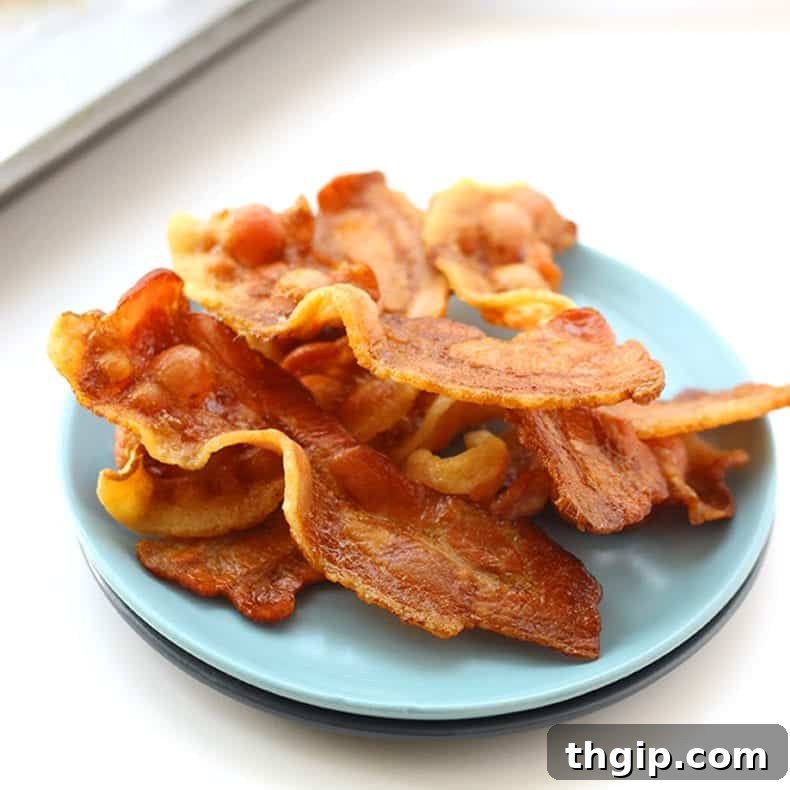
No need to worry about clean up or grease splatter with this easy tutorial on how to cook bacon in the oven for the crispiest bacon. Just preheat, line up the bacon and bake and you have the perfect bacon in under 15 minutes!
The Ultimate Guide to Crispy Oven-Baked Bacon: No Mess, Perfect Every Time!
Welcome back to another month of Healthy How-Tos! This year, we’re dedicated to bringing you simple yet effective kitchen hacks and recipes that make healthy eating not just achievable, but truly enjoyable. Last month, we mastered the art of making green juice in your blender, a huge hit for those seeking a refreshing start. But now, as we move past the January detox, it’s time to indulge a little and bring on the bacon – but with a healthy, no-fuss twist!
You might be thinking, “bacon isn’t healthy.” In my culinary philosophy, enjoyed thoughtfully and sourced consciously, it absolutely can be a part of a balanced diet. Since becoming a true bacon enthusiast, I’ve discovered countless delicious ways to incorporate this savory delight into meals without overdoing it. The key lies in mindful consumption and, crucially, selecting high-quality meat. Eating bacon with every single meal might not be the most balanced strategy, but occasionally savoring well-prepared bacon, especially when it’s organic and local, can be a delightful and satisfying addition to your healthy eating journey.
While I adore the irresistible taste and versatility of bacon, the traditional stovetop cooking method often leaves much to be desired. The lingering smell that permeates the house, the dreaded hot oil splattering onto your skin and all over your pristine kitchen surfaces, and the constant need to babysit the pan can quickly turn a simple pleasure into a frustrating chore. That’s precisely why I embarked on a mission to find a better, cleaner, and significantly more efficient way to achieve perfectly crispy bacon.
Enter the humble oven – a true unsung hero of the kitchen! Not only does it provide a welcoming warmth on those brutally chilly days (a true lifesaver when it’s -35 degrees outside, a genuine experience!), but it also offers an incredibly hands-off method for cooking a wide array of foods. When it comes to bacon, the oven profoundly transforms an often messy and labor-intensive process into a simple, straightforward task, consistently delivering the crispiest, most flavorful, and utterly fuss-free bacon you’ve ever had the pleasure of tasting. Let’s dive into how this magical method works and why it will fundamentally change your bacon-making game forever.
Why Oven-Baked Bacon is the Best Cooking Method
If you’re still cooking bacon on the stovetop, prepare to have your mind completely changed. Oven-baking bacon is not merely a convenience; it’s a vastly superior cooking method that offers a multitude of compelling benefits, consistently ensuring delicious results with significantly less effort and mess than traditional pan-frying.
- Effortless Perfection: The consistent, enveloping dry heat of the oven cooks bacon evenly from all sides without the need for constant supervision or flipping. This leads to perfectly crispy strips, every single time, free from burnt edges or stubbornly undercooked, chewy bits.
- Hands-Off Convenience: Once the bacon is neatly arranged and placed in the oven, your active involvement is largely complete. There’s no more standing vigilantly over a hot stove, constantly monitoring and painstakingly turning individual strips. This liberating aspect frees up your hands and precious stovetop space to comfortably prepare other essential components of your meal, transforming breakfast or brunch prep into an absolute breeze.
- Stress-Free Cleanup: This benefit is arguably the biggest game-changer for many home cooks. By diligently lining your baking sheet with a sheet of parchment paper, you effectively contain all the rendering grease and drippings. Once the grease has cooled and solidified, simply wrap up the parchment paper (with the grease contained) and dispose of it – eliminating the need for arduous scrubbing of greasy pans!
- Reduced Splatter and Odor: Bid a joyous farewell to hot oil splattering dangerously on your counters, clothes, and delicate skin. The enclosed environment of the oven keeps the mess completely contained, ensuring a remarkably cleaner and notably safer cooking experience. Furthermore, the overall bacon aroma tends to be less pervasive throughout your home compared to stovetop frying.
- Batch Cooking Friendly: Do you need to cook a large quantity of bacon for a bustling crowd, a substantial family breakfast, or for efficient meal prepping throughout the week? The oven quickly becomes your most invaluable ally. You can effortlessly fill one or even two large baking sheets, making this method perfectly ideal for feeding families or entertaining guests.
- Consistent Temperature Control: Ovens inherently provide a far more stable and uniform cooking environment than an open stovetop pan, which can often develop unpredictable hot spots. This inherent stability leads to more predictable and beautifully uniform results across all your bacon strips, ensuring each piece is cooked to crispy perfection.
Choosing the Best Bacon for Optimal Oven Roasting
The initial quality of your bacon profoundly influences the final taste, texture, and overall enjoyment of your meal. For the absolute best oven-baked bacon experience, I strongly advocate for prioritizing quality. Here’s a comprehensive guide on what to discerningly look for:
- Thick-Cut Varieties: While you can certainly cook thinner-cut bacon in the oven, thick-cut varieties consistently tend to yield a more satisfying, substantial, and meaty texture, complemented by delightfully crispy edges. They also prove to be much more forgiving during the cooking process and are significantly less prone to burning prematurely.
- Organic, Pasture-Raised, and Local Sources: Whenever it’s feasible, make the conscious choice to opt for organic, pasture-raised, or locally sourced bacon. These superior options typically originate from animals raised without the routine use of antibiotics or artificial hormones, and they are often fed a more natural, wholesome diet. This translates directly into better flavor, improved texture, and often a more favorable nutrient profile.
- Nitrate/Nitrite-Free Options: A significant number of standard, commercially produced bacons contain synthetic nitrates and nitrites, alongside often excessive amounts of added sugars and artificial ingredients that are notoriously difficult to pronounce. Actively seek out “uncured” bacon that utilizes natural celery powder or other natural agents for curing, and always diligently check the ingredient list for any unnecessary additives. A shorter, more recognizable ingredient list is consistently a strong indicator of higher quality.
- Explore Diverse Flavor Profiles: Beyond the ubiquitous basic smoked bacon, don’t hesitate to explore and experiment with different flavor profiles. Varieties like applewood smoked, hickory smoked, or peppered bacon can introduce an exciting extra dimension and complexity to your dishes, elevating your bacon experience.
Essential Tools for Achieving Perfect Oven-Baked Bacon
Before you embark on your journey to perfect oven-baked bacon, ensure you have these simple yet crucial tools readily available. They are fundamental to guaranteeing a smooth, safe, and undeniably successful bacon-baking experience:
- Rimmed Baking Sheet: This is an absolutely crucial item, essential for effectively catching all the rendering grease and preventing any messy spills inside your oven. A standard half-sheet pan (typically 13×18 inches) works perfectly and is widely available.
- Parchment Paper: Consider this your ultimate secret weapon for dramatically simplifying cleanup! Parchment paper ingeniously creates a non-stick surface, efficiently contains all the hot grease, and allows for incredibly quick and effortless disposal after cooking. While aluminum foil can also function, parchment paper is generally superior due to its inherent non-stick properties and, for the environmentally conscious, its potential for compostable options.
- Heat-Resistant Tongs: These are absolutely essential for safely and easily transferring hot bacon strips from the scorching baking sheet to a waiting plate without burning your fingers.
- Absorbent Paper Towels: Indispensable for draining any excess grease from the freshly cooked bacon. This critical step ensures maximum crispness and reduces the overall oiliness of your finished product.
- Reliable Oven Mitts: Always, without exception, use robust oven mitts or heat-resistant gloves when handling hot baking sheets to prevent severe burns.
- Optional: Wire Cooling Rack: For bacon that reaches an even higher echelon of crispness, consider placing a sturdy wire rack directly on top of your parchment-lined baking sheet. This ingenious elevation allows hot air to circulate freely around all sides of each bacon strip, preventing it from languishing in its own rendered fat and promoting unparalleled crispiness.
How To Cook Bacon In Your Oven: A Step-by-Step Recipe
Yield: Approximately 12-14 strips of bacon
Prep time: 2 minutes
Cook time: 13-16 minutes
Ingredients:
- 1 lb thick-cut, organic bacon strips
- Parchment paper (or aluminum foil for lining)
- 1 large rimmed baking sheet (or two, if cooking more bacon)
Instructions:
- Preheat your oven: Begin by setting your oven to a precise 400 degrees Fahrenheit (approximately 200 degrees Celsius). Allowing the oven to fully preheat ensures it is at the correct, consistent temperature for even cooking when the bacon is introduced.
- Prepare your baking sheet: Carefully line a sturdy rimmed baking sheet with a sheet of parchment paper. This vital step is the cornerstone for easy cleanup and also effectively prevents the bacon from sticking to the pan. If you’ve chosen to use a wire rack for extra crispness, now is the time to place it securely on top of the parchment paper.
- Arrange the bacon strips: Lay the individual bacon strips in a single, neat layer across the prepared baking sheet (or directly onto the wire rack). It’s crucial to avoid overlapping them, as overcrowding will lead to steaming rather than frying, resulting in uneven cooking and significantly less crispness. For a full pound of bacon, you might find it necessary to use two separate baking sheets to ensure adequate spacing.
- Bake to perfection: Gently place the loaded baking sheet into your preheated oven and allow it to bake for a duration of 13-16 minutes. The precise cooking time will largely depend on the specific thickness of your bacon and your personal preference for its level of crispness. For exquisitely crispy bacon, 14 minutes is frequently cited as the ideal “magic number.” If you prefer a slightly less crispy, more pliable texture, reduce the baking time by a minute or two; conversely, for truly extra-crispy results, extend the baking time by a few minutes. A key advantage of this method is that there is absolutely no need to flip the bacon during cooking.
- Monitor for desired crispness: It is important to maintain a close watch on the bacon, particularly as the cooking time draws to a close, as bacon can transition from perfectly done to regrettably burnt very rapidly. Look for a rich, deep golden-brown color and a visibly firm, rendered texture.
- Drain the excess grease: Once the bacon has achieved your desired level of crispness, carefully remove the hot baking sheet from the oven. Using your trusty tongs, promptly transfer the cooked bacon strips to a waiting plate that has been generously lined with several layers of absorbent paper towel. This critical step will effectively absorb any lingering excess grease, contributing to bacon that is even crispier and less oily.
- Pat and serve: For an ultimate finish, you can gently pat the top of the bacon with an additional paper towel to remove any remaining surface grease. Serve your perfectly crispy, oven-baked bacon warm and prepare to savor every delightful bite!
*Please note that exact cooking times may exhibit slight variations depending on your specific oven’s calibration, its individual quirks, and the total number of baking sheets you have simultaneously in the oven. While 14 minutes is often my preferred benchmark, always pay close attention and adjust as necessary to meticulously achieve your preferred texture and doneness.
**While this method is primarily optimized for traditional pork bacon, I anticipate that turkey bacon would require a broadly similar cooking time, although the final results might vary subtly due to the differing fat content and composition of turkey bacon.
Expert Tips for Achieving the Crispiest Oven Bacon Every Time
Achieving consistently crispy bacon is often considered an art, but with these proven professional tips, you are virtually guaranteed to reach a state of crunchy perfection with every single batch:
- Consider Starting with a Cold Oven (Optional but Highly Recommended): An excellent technique is to place your raw bacon in a cold oven and then allow it to preheat along with the oven. This gradual and even heating allows the bacon fat to render slowly and uniformly, which is crucial. This slow rendering process helps prevent the bacon from shrinking excessively, promotes thorough cooking, and ultimately ensures maximum crispness across the entire strip. If you are pressed for time, starting with an already preheated oven is perfectly acceptable, but for truly superior and consistently exceptional results, I highly encourage trying the cold oven method.
- Always Use a Wire Rack: As previously emphasized, employing a wire cooling rack placed over your parchment-lined baking sheet is a game-changer. This elevation elegantly lifts the bacon out of its own rendering fat, allowing hot air to circulate freely around all sides of each strip. This unrestricted airflow promotes supremely even browning and crucially prevents the bottom of the bacon from becoming soggy or steamy. It’s a remarkably simple upgrade that yields dramatically extra-crispy results.
- Never Overcrowd the Pan: It is paramount to give each individual bacon strip ample space to breathe and cook. Overlapping or excessively overcrowding the baking sheet will inevitably cause the bacon to steam rather than fry, leading to an undesirable chewy texture and disappointingly inconsistent results. If necessary, always opt to use two separate baking sheets to ensure proper spacing.
- Adjust Cooking Time According to Thickness: Recognize that not all bacon is created equal. Thinner-cut bacon will naturally cook much faster, while robust thick-cut bacon will invariably require more extended cooking time. Therefore, it is essential to always keep a watchful eye on your bacon and be prepared to adjust the baking time by a minute or two as needed, precisely matching your preferred level of crispness and doneness.
- Pat Dry Before Baking for Extra Crispness: For bacon with an exceptionally crisp edge and texture, take a moment to gently pat your raw bacon strips dry with clean paper towels just before you arrange them on the baking sheet. Removing any surface moisture helps them crisp up more rapidly and intensely in the oven’s dry heat.
- Cook in Batches When Necessary: If you are preparing an exceptionally large quantity of bacon, it is far more effective to cook it in smaller batches. This prevents overcrowding the oven, which can significantly drop the oven’s temperature and compromise the crispness of your bacon.
Creative Ways to Enjoy Your Perfectly Oven-Baked Bacon
Once you’ve flawlessly mastered the art of oven-baked bacon, the culinary possibilities that open up are truly endless and exciting! Here are some inspiring ideas to elevate your next meal and showcase your perfectly cooked crispy bacon:
- The Quintessential Breakfast or Brunch Platter: This is, of course, the most classic and satisfying choice! Serve your golden, crispy bacon proudly alongside fluffy scrambled eggs, a stack of warm pancakes or waffles, or a refreshing bowl of fresh fruit salad for a truly complete meal.
- The Ultimate BLT Sandwiches: Perfectly crispy bacon is an absolute, non-negotiable requirement for constructing an exemplary BLT. Its crunch contrasts beautifully with soft bread, ripe tomatoes, and crisp lettuce.
- Gourmet Salad Topping: Crumble your delicious oven-baked bacon over virtually any salad for an instant burst of savory flavor and a supremely satisfying textural crunch. Imagine it gracing a classic Cobb salad, a zesty Caesar salad, or even a simple, elegant spinach salad.
- Burger or Sandwich Enhancer: Elevate your favorite burger, grilled cheese, or club sandwich by adding a generous couple of strips of your perfectly cooked bacon. It adds a smoky, salty dimension that transforms an ordinary meal into an extraordinary one.
- Hearty Soup and Stew Garnish: Finely crumbled bacon bits introduce an incredible depth of savory flavor and a delightful textural contrast to creamy, comforting soups (such as potato or corn chowder) and robust, hearty stews.
- Delectable Appetizers: Get creative by wrapping slender strips of bacon around sweet dates, tender asparagus spears, or succulent shrimp before baking them. This simple technique results in surprisingly delicious and incredibly easy-to-make appetizers that are sure to impress.
- Flavoring for Roasted Vegetables: Introduce a new dimension of flavor to your vegetable dishes. Add chopped crispy bacon to roasted Brussels sprouts, sautéed green beans, or sprinkle generously over creamy baked potatoes.
- Homemade Bacon Jam: Dedicate a portion of your glorious crispy bacon to create a rich, savory-sweet bacon jam. This addictive condiment is perfect for spreading on crackers, crusty toast, or even as a unique topping for burgers.
Troubleshooting Common Oven Bacon Problems
Even with the most effective cooking methods, sometimes unforeseen circumstances can arise. Here’s how to effectively troubleshoot and resolve common issues you might encounter when oven-baking bacon, ensuring you achieve perfect results every time:
- Soggy or Chewy Bacon:
- Common Causes: This usually results from overcrowding the pan, inadequate drainage after cooking, or simply undercooking the bacon to its desired crispness.
- Effective Solutions: Always ensure that the bacon strips are laid out in a single, uncrowded layer on the baking sheet. Utilize a wire rack whenever possible to promote better airflow. Critically, always drain the cooked bacon thoroughly on several layers of paper towels immediately after removing it from the oven. If necessary, extend the baking time slightly until it reaches your preferred crispness.
- Burnt Bacon:
- Common Causes: Burnt bacon is typically a result of the oven temperature being excessively high, cooking the bacon for too long, or using thin-cut bacon but baking it for times intended for thick-cut varieties.
- Effective Solutions: Consider lowering your oven temperature slightly (e.g., to 375°F/190°C) or significantly reducing the cooking duration. It is crucial to always monitor the bacon very closely, especially when you are trying out a new oven or an unfamiliar type of bacon.
- Unevenly Cooked Bacon:
- Common Causes: Uneven cooking often stems from overlapping bacon strips, the presence of inconsistent hot spots within your oven, or bacon strips having widely varying thicknesses.
- Effective Solutions: Reiterate the importance of a single, uncrowded layer. If your oven is known to have hot spots, make it a practice to rotate the baking sheet halfway through the total cooking time. For bacon that is very unevenly cut, you might need to manually remove thinner pieces earlier to prevent them from burning while the thicker pieces finish cooking.
Cleaning Up Made Easy: The Unbeatable Oven Bacon Advantage
One of the most universally cherished and frequently celebrated benefits of oven-baking bacon is the incredibly straightforward and remarkably easy cleanup process. Here’s how to make it virtually mess-free, allowing you to enjoy your delicious bacon without dreading the aftermath:
- Allow the Grease to Cool: After removing the bacon, allow the rendered bacon grease accumulated on the parchment paper to cool down completely. As it gradually cools, the grease will solidify, making it exponentially easier and safer to handle and dispose of.
- Wrap and Toss: Once the grease has firmly solidified, simply gather and wrap up the parchment paper (with all the contained, solidified grease) and hygienically toss it into your trash bin. This method cleverly circumvents the need to pour potentially hot, liquid grease down your kitchen drain, a practice that can lead to severe and costly plumbing clogs over time.
- Minimal Pan Washing: Because the parchment paper has so effectively contained all the grease and mess, your baking sheet will most likely only require a quick wipe with a paper towel or a very light wash with a mild soap and warm water. Say goodbye to strenuous scrubbing and stubborn baked-on residue!
Frequently Asked Questions About Oven-Baked Bacon
- Can I use aluminum foil instead of parchment paper for oven-baked bacon?
- Yes, you can certainly use aluminum foil as an alternative. It also serves the purpose of simplifying cleanup. However, parchment paper is generally preferred by many cooks because bacon is less likely to stick to its surface, and it won’t react with the bacon (aluminum can sometimes interact with acidic foods, although this is less of a concern with bacon).
- Do I need to flip the bacon while it’s cooking in the oven?
- No, one of the most significant advantages and beauties of the oven-baking method is that the radiant heat cooks both sides of the bacon evenly and simultaneously, completely eliminating the need for you to manually flip the bacon during the cooking process.
- Can I cook frozen bacon directly in the oven?
- For the most consistent and evenly crispy results, it is generally recommended to thaw bacon thoroughly before cooking. However, if you find yourself in a time crunch, you can cook frozen bacon in the oven. Be aware that it will require a longer cooking time (typically add an extra 5-10 minutes to the recommended duration) and might not achieve the same uniform crispness as thawed bacon. Try to separate the strips as much as possible before baking.
- How should I properly store cooked bacon?
- Once your delicious oven-baked bacon has cooled completely to room temperature, store it securely in an airtight container or a well-sealed plastic bag in the refrigerator. It will remain fresh and tasty for up to 4-5 days. For longer storage, cooked bacon can also be safely frozen for up to a month.
- What can I do with the leftover bacon grease?
- Resist the urge to discard all of it! Allow the rendered bacon grease to cool and solidify, then strain it through a fine-mesh sieve (to remove any lingering food particles) into a clean, heat-proof jar. Store this valuable liquid gold in your refrigerator. It’s a fantastic, flavorful fat that can be expertly used for cooking eggs, sautéing a variety of vegetables, or adding a rich, smoky depth of flavor to cornbread or other savory dishes. It’s a true culinary enhancer!
Conclusion: Your New Favorite Way to Cook Bacon
Cooking bacon in the oven is truly a revolutionary game-changer in the kitchen. It stands as the simplest, cleanest, and most foolproof method available to achieve perfectly crispy, consistently delicious bacon every single time you crave it. You can confidently say goodbye to greasy stovetops, the monotonous task of constant flipping, and the frustrating unpredictability of inconsistent results.
With just a few minimal minutes of initial preparation and the incredible efficiency of your oven, you’ll be effortlessly enjoying flawless bacon, freeing up your valuable time and transforming meal preparation into a genuinely joyful and satisfying experience.
So, the next time that irresistible craving for a savory, crispy crunch strikes, bypass the old skillet and head straight for your oven. You will not regret making this culinary switch!
Want More Easy Kitchen Hacks? Check out these posts:
How To Make Chia Pudding – 5 ways!
How to Make Grilled Chicken on the Stove Top
How To Make Bone Broth In Your Slow Cooker