
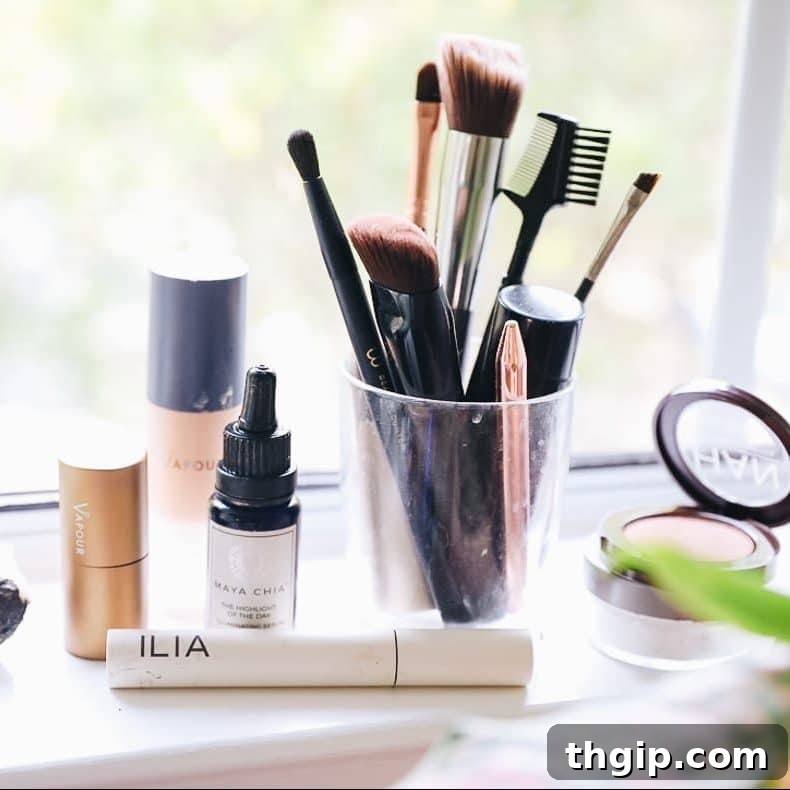
The journey to embracing cleaner beauty products often begins with a sense of overwhelm. Many of you have reached out, eager to transition to healthier makeup options but unsure where to start. While I’ve shared countless recommendations in my green beauty shop over the years, a crucial question remains: what about the makeup you already own? Is it time to discard it? More importantly, how can you identify the truly toxic ingredients lurking in your beauty bag? It’s time to demystify these concerns, providing you with the knowledge and confidence to make informed decisions for your well-being.
I understand that everyone’s path to cleaner living is unique, shaped by individual priorities, access to resources, and personal beliefs. And that’s perfectly okay. If a complete overhaul to natural makeup products isn’t right for you at this moment, I completely respect that. Feel free to bookmark this post and revisit it whenever you feel ready. However, if you’re prepared to dive into the world of cleaner makeup, this comprehensive guide will illuminate the most common toxic ingredients in makeup products and equip you with vital information about making non-toxic choices. Let’s embark on this empowering journey together.
Navigating the World of Clean Beauty: Identifying and Avoiding Toxic Ingredients in Makeup
What Exactly is Non-Toxic Makeup? Understanding the Clean Beauty Landscape
Before we delve into specific ingredients, let’s clarify what “non-toxic makeup” truly means. While I personally find the term “non-toxic” a bit absolute and prefer “clean beauty,” I’ll use them interchangeably for simplicity today. Essentially, non-toxic makeup refers to products formulated without certain known, harmful ingredients that have been linked to adverse health effects. This raises a pressing question: Does conventional makeup contain ingredients that are demonstrably detrimental to our bodies? Regrettably, the answer is often yes.
The regulatory landscape for cosmetics varies drastically across the globe. In the United States, the list of ingredients prohibited in beauty products has remained largely unchanged since 1938, banning a mere 30 substances. Contrast this with Canada, which restricts over 500 ingredients, and the European Union, which bans more than 1,300 chemicals from cosmetic formulations (source). This stark disparity means that thousands of ingredients deemed too hazardous for use in beauty products in other developed nations are still freely permitted in US formulations. This situation is frankly astounding. Consequently, the responsibility of safeguarding your health largely falls upon you, the consumer, to meticulously read ingredient labels and educate yourself on which substances pose potential risks. My aim with this guide is to empower you in that critical task.
Toxic vs. Synthetic: Unpacking the Reality of Makeup Ingredients
Before we jump into the specific ingredients to avoid in your makeup routine, it’s crucial to have a nuanced discussion about the distinction between “toxic” and “synthetic.” The truth is, most makeup products—whether labeled “clean” or not—will contain a significant proportion of synthetic ingredients. This isn’t inherently problematic. The mere fact that an ingredient is created in a laboratory doesn’t automatically mean it’s harmful to your body. The key lies in understanding which synthetic ingredients are safe and stable, and which ones carry known risks.
So, don’t be alarmed if you examine your “natural” mascara and find a list of chemical-sounding names. It takes practice and a bit of learning, but over time, you’ll develop the ability to discern which compounds are harmless or even beneficial, and which should be avoided. Unlike skincare, which can often be formulated more simply with plant-derived ingredients, makeup frequently requires more sophisticated laboratory assistance to achieve specific colors, textures, and long-lasting finishes. While it’s easier to switch to clean skincare and bodycare, remember that “clean” makeup might not always align with a purely “plant-based” or “raw” definition of clean. It’s about smart, safe formulation, not just natural origin.
8 Key Toxic Ingredients to Avoid in Your Makeup Bag
Now that we’ve addressed the important distinction between toxic and synthetic, let’s turn our attention to the specific ingredients you should endeavor to avoid in your makeup collection. It’s important to note that this list is not exhaustive. As previously mentioned, thousands of ingredients banned in other countries are still permitted in US personal care products. Instead of overwhelming you with an impossibly long list, I’ve focused on the most common, well-researched, and potentially harmful substances that frequently appear in conventional makeup.
1. Formaldehyde and Formaldehyde-Releasing Preservatives
Though largely banned in the European Union, formaldehyde and its various “releasers” continue to be used in US personal care products primarily as preservatives to inhibit bacterial growth. Manufacturers often claim the amounts are too small to be harmful, but repeated, long-term exposure to these chemicals has been consistently linked to poorer health outcomes, including skin irritation, allergic reactions, and even a classification as a known human carcinogen by the International Agency for Research on Cancer (IARC). You often won’t see “Formaldehyde” directly listed. Instead, look out for these common formaldehyde-releasing names on your makeup labels: Diazolidinyl urea, Imidazolidinyl urea, DMDM Hydantoin, Quaternium-15, Nitorpropane-1, Formalin, Methanal, Methyl Aldehyde, and Methylene Oxide. These are often found in liquid foundations, mascaras, and other water-based products.
2. Triclosan: A Hormone Disruptor
Despite being a well-documented endocrine-disruptor with significant implications for hormone balance and fertility (and completely banned in the EU!), Triclosan remains a common antibacterial and antifungal agent added to various water-based personal care products. Its presence is particularly concerning due to its ability to interfere with thyroid function and contribute to antibiotic resistance. You are most likely to encounter Triclosan in liquid products such as foundations, concealers, mascaras, and lip glosses. When scrutinizing ingredient lists, look for these common names: Irgasan DP-300, Lexol 300, Ster-Zac, and Cloxifenolum.
3. Parabens: Pervasive Preservatives with Endocrine Effects
Similar to triclosan, parabens are a class of widely used preservatives proven to be associated with endocrine disruption. Research indicates a link between paraben exposure and a range of concerning health issues, including certain types of breast cancer, reduced sperm count, and skin cancer. Their mechanism often involves mimicking estrogen in the body, which can disrupt delicate hormonal balances. Parabens are particularly prevalent in liquid makeup products. To identify them, look for ingredient names ending in “paraben,” such as: isopropylparaben, isobutylparaben, phenylparaben, benzylparaben, and pentylparaben.
4. Phthalates: The “Fragrance” Hidden Hazard
While often challenging to pronounce, phthalates are relatively easy to avoid once you know what to look for. These plasticizing chemicals are notorious endocrine-disruptors linked to a spectrum of health problems, including fertility issues, obesity, developmental defects in children, and even certain cancers. Phthalates are most commonly found hidden within ingredients listed simply as “fragrance” or “parfum.” Because manufacturers are not required to disclose the specific chemicals used to create a fragrance, “fragrance” acts as a loophole for a cocktail of undisclosed chemicals, often including phthalates. It is strongly advised to avoid any product using synthetic fragrance, as there are no known benefits and numerous potential downsides. While typically listed as fragrance, you might occasionally see specific chemical names like: BBP: butyl benzyl phthalate, DBP: di-n-butyl phthalate, DEHP: di-(2-ethylhexyl) phthalate – though this list of variations is extensive.
5. Lead: The Unlisted Neurotoxin in Color
Banned in nearly every other developed nation, lead, a potent neurotoxin with established detrimental effects on fertility and brain development, can still be found as a contaminant in cosmetics – most notably in lipstick. The insidious nature of lead in makeup is that it will never be listed as an intentional ingredient. Instead, it appears in trace amounts as an impurity in coloring agents and dyes. This is particularly alarming given that lipstick is often ingested throughout the day. Reputable clean beauty brands prioritize transparency by indicating the source of their colorants and often conduct rigorous 3rd party testing to ensure lead-free products. Conversely, many conventional beauty brands, especially those producing cheaper products, do not offer such assurances, making their colorants a higher risk for lead contamination. Always prioritize brands that explicitly state their commitment to heavy metal testing.
6. Petroleum (and its Derivatives): More Than Just a Filler
It might come as a surprise, but the same crude oil used to fuel vehicles can also be found in your makeup products! Petroleum, often a known carcinogen and associated with estrogen dominance, is utilized in cosmetics primarily for its exceptional ability to seal in moisture and create a barrier. While it is effective at this, the problem lies in its inability to be metabolized by the body; once ingested or absorbed, it can persist. Beyond its potential health concerns, petroleum is often merely a cheap filler and is far from a sustainable ingredient. Look for it and its derivatives under names such as: paraffin wax, mineral oil, toluene, benzene, toluol, phenylmethane, and methylbenzene.
7. Propylene Glycol: A Common Irritant
Another byproduct of crude oil, propylene glycol, serves as both a stabilizer and a solvent in many cosmetic formulations. Commonly found in foundations and lipsticks, propylene glycol has been shown to contribute to skin dryness and can lead to irritation and allergic contact dermatitis over time, particularly for those with sensitive skin. From an environmental standpoint, it’s not the most sustainable choice. From a health perspective, while it’s generally more of an irritant than an extremely toxic substance at typical cosmetic concentrations, repeated exposure can still be problematic for skin health. It’s definitely an ingredient to be mindful of. You may also find it listed under the name: propane-1,2-diol.
8. Butylated Compounds (BHT + BHA): Antioxidants with a Dark Side
Butylated Hydroxyanisole (BHA) and Butylated Hydroxytoluene (BHT) are widely used as synthetic antioxidants and preservatives, not only in food but also extensively in cosmetics. While they are effective at preventing product degradation, they are also recognized endocrine-disruptors. BHA, in particular, has been classified as a possible human carcinogen by the National Toxicology Program and can cause allergic reactions. Both BHA and BHT have been linked to organ toxicity at higher levels of exposure and are known skin and respiratory irritants. Always check for these names on your labels: butylated hydroxyanisole (BHA) and butylated hydroxytoluene (BHT).
* * * * *
I understand that encountering this extensive list of toxic ingredients in makeup can feel overwhelming. Please trust me – I’ve been there. The goal isn’t to achieve perfection overnight, so there’s absolutely no need to panic or toss everything out immediately. The aim is gradual progress and informed choices. In an upcoming post, I will delve into practical strategies for transitioning your makeup bag from conventional to non-toxic options, providing actionable steps and product recommendations. For now, my primary wish is for you to feel informed, empowered, and equipped to make the best decisions for your personal health and beauty regimen. While this list doesn’t cover every single potentially harmful ingredient, it highlights the most common and scientifically validated toxins. Stay tuned for more insights and guidance on your journey to cleaner beauty.
Like this post? Here are a few others you might enjoy for further reading:
- Discover the Best Natural Mascaras for a Healthier Look
- Explore the Best Non-Toxic Foundations for Flawless Skin
- Find Your Perfect Natural Blush for a Radiant Glow