
The Skinny on Fat: Why Eating Healthy Fats WON’T Make You Fat!
For too long, dietary fat has been unfairly demonized. Phrases like “fat makes you fat” and “fat is higher in calories, so count every single one” became ingrained in our collective consciousness. Many of us, myself included, once adhered strictly to these beliefs and restrictive food rules. Thankfully, a growing understanding of nutrition has allowed us to question these long-held assumptions and embrace the truth: not all fats are created equal, and healthy fats are absolutely essential for a thriving body. It’s time to shed the fear and dive into the real story behind dietary fat, debunking myths and highlighting why it’s a vital component of a balanced diet.
The Era of Low-Fat: A Misguided Journey
Many of us remember, or perhaps are still living through, the phase where fat was unequivocally labeled as “bad.” You’re certainly not alone in this experience. Surveys consistently show that a significant portion of the population remains wary of dietary fat. Personally, during my low-fat diet days, I found myself constantly exhausted, persistently hungry, and feeling mentally clouded – as if living in a perpetual fog. It wasn’t until I delved into the science that it all clicked. Fat is not just desirable; it is absolutely necessary for our health.
The widespread recommendation for all Americans to follow a low-fat diet first emerged in 1977. This pivotal moment initiated decades of dietary advice that, in hindsight, may have contributed to unforeseen public health challenges. While the exact motivations behind this shift are complex and involve intricate layers of politics, economics, and agricultural interests, the impact was profound. Food manufacturers began stripping fat from products, often replacing it with refined sugars and carbohydrates to maintain palatability. This substitution inadvertently led to an increase in calorie-dense, nutrient-poor foods in our diets.
Despite significant scientific advancements and countless studies conducted over the past four decades, the legacy of the low-fat protocol persists in many organizations and popular diet trends. However, mounting evidence has consistently demonstrated that low-fat diets are generally not more effective for sustainable weight loss or for promoting overall long-term health. The truth is, our bodies require all three macronutrients – carbohydrates, proteins, and fats – to function optimally and thrive. Eliminating or drastically reducing any one of them can create imbalances and nutrient deficiencies, hindering our body’s natural processes. Fortunately, a paradigm shift is underway, with health organizations and research bodies finally acknowledging the indispensable role of healthy fats.
Why Fat is Not the Enemy: Its Essential Role in Your Body
The idea that a low-fat diet helps with weight loss is a common misconception. In reality, when fat is removed from food products, manufacturers often compensate by adding sugar to preserve flavor and texture. It’s crucial to understand that this discussion isn’t about pitting sugar (carbohydrates) against fat. Both are vital for survival. However, the critical point is that when one macronutrient is removed or significantly reduced, another typically steps in to fill its void. The goal should always be to achieve a balanced, sustainable eating pattern that nourishes your body and helps you avoid the endless cycle of restrictive dieting followed by binges.
Beyond weight management, fat is a cornerstone of our overall health. Our bodies rely on dietary fat for a multitude of critical functions. It’s a concentrated source of energy, powering our cells and organs throughout the day. Fat plays a fundamental role in supporting a healthy metabolism, ensuring that our bodies efficiently convert food into energy. It is crucial for growth and development, particularly in children. Furthermore, fat is integral to a robust immune system, helping our bodies fight off illness and infection. Quite simply, we cannot survive without fat; it’s plain and simple physics and biology.
Healthy fats are also essential for the absorption of fat-soluble vitamins – A, D, E, and K. Without sufficient fat in your diet, your body struggles to absorb these vital nutrients, potentially leading to deficiencies that impact everything from bone health and vision to immune function and antioxidant protection. Moreover, fats keep our skin supple and healthy, provide insulation, and protect our organs. They are fundamental components of cell membranes and are indispensable for hormone production. Perhaps one of the most significant roles of fat is in brain health; our brains are composed largely of fat, and essential fatty acids are crucial for cognitive function, mood regulation, and nerve signal transmission. Finally, fat contributes significantly to satiety, helping us feel full and satisfied after meals, which can naturally lead to reduced overall calorie intake and improved eating patterns.
Distinguishing Between Good, Bad, and Nuanced Fats
When I first started truly researching and thinking critically about fats, I realized how much I needed to unlearn and relearn! The world of dietary fats is far more complex than a simple “good” or “bad” label suggests. Generally, fats can be broadly categorized into trans fats, saturated fats, and unsaturated fats. Understanding these distinctions is key to making informed dietary choices.
Unsaturated Fats: The Heart-Healthy Heroes
Unsaturated fats are widely regarded as the most beneficial for heart health and overall well-being. These include monounsaturated fatty acids (MUFAs) and polyunsaturated fatty acids (PUFAs). These fats are typically liquid at room temperature and contribute to lower cholesterol levels, reduced inflammation, and improved cardiovascular health.
- Monounsaturated Fats (MUFAs): Found in foods like olive oil, avocados, almonds, and pecans, MUFAs are known for their ability to help reduce bad (LDL) cholesterol levels while potentially increasing good (HDL) cholesterol. They play a vital role in maintaining heart health and can have anti-inflammatory effects within the body.
- Polyunsaturated Fats (PUFAs): These are often referred to as “essential” fats because our bodies cannot produce them and must obtain them from food. PUFAs include the well-known Omega-3 and Omega-6 fatty acids. While both are crucial, a healthy balance between them is important for optimal health.
- Omega-3 Fatty Acids: These powerful anti-inflammatory fats are critical for brain function, eye health, and reducing the risk of chronic diseases. There are three main types: ALA (Alpha-Linolenic Acid), found in plant sources like walnuts, flaxseeds, and chia seeds; and EPA (Eicosapentaenoic Acid) and DHA (Docosahexaenoic Acid), predominantly found in fatty fish such as salmon, mackerel, and sardines. Walnuts are particularly unique as they are the only tree nut to provide a significant source of plant-based ALA Omega-3.
- Omega-6 Fatty Acids: Found in various vegetable oils (like soybean, corn, and sunflower oil) and nuts, Omega-6s are also essential. However, the typical Western diet often contains an excess of Omega-6s compared to Omega-3s, which can contribute to inflammation. Striving for a better balance is beneficial.
Great Sources of Good Fats to Incorporate Daily:
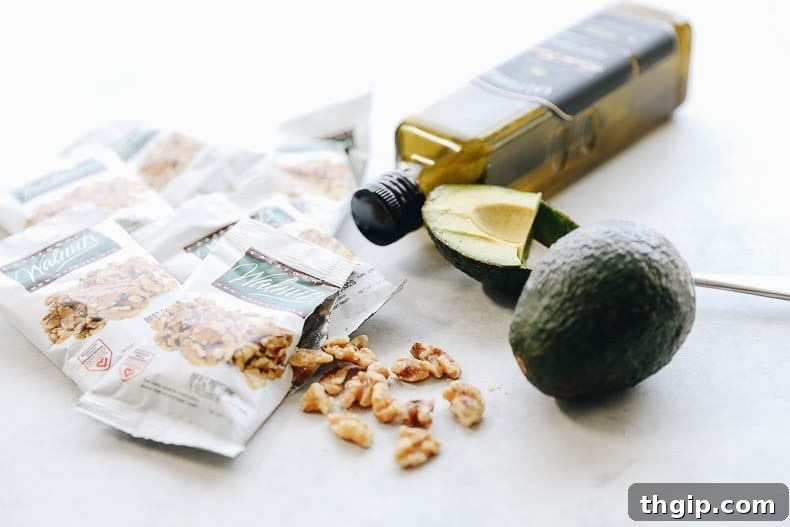
- Walnuts: An exceptional source of plant-based omega-3 ALA. Walnuts are unique with 72% of their total fat coming from USDA-recommended polyunsaturated fats. They are also incredibly delicious and versatile, perfect for snacking, baking, or adding to salads and main dishes.
- Avocado: Rich in monounsaturated fats, fiber, and various vitamins and minerals.
- Salmon: An excellent source of EPA and DHA omega-3s, along with high-quality protein.
- Olive Oil: Especially extra virgin olive oil, which is packed with monounsaturated fats and antioxidants. Ideal for cooking at moderate temperatures and dressing salads.
- Seeds: Chia seeds, flax seeds, and hemp seeds are loaded with omega-3s, fiber, and protein.
- Other Nuts: Almonds, pecans, and cashews offer healthy fats, fiber, and micronutrients.
The Real “Bad” Fats: Trans Fats and Their Dangers
While there’s ongoing debate about some fat types, one thing nearly all health experts agree on is the detrimental impact of artificial trans fats. These fats are created through a process called hydrogenation, which turns liquid vegetable oils into solid fats. Consuming trans fats and high amounts of certain saturated fats (especially those from highly processed foods) can lead to a host of health issues, including an increased risk of heart disease, type 2 diabetes, and heightened systemic inflammation.
Fortunately, significant progress has been made on this front. The U.S. government officially banned artificial trans fats, requiring their elimination from most food products by June 2018. This was a monumental step forward for public health. However, it’s still wise to check food labels for “partially hydrogenated oils,” which is a tell-tale sign of artificial trans fats.
Examples of Artificial Unhealthy Fats to Avoid:
- Margarine (especially older formulations with partially hydrogenated oils)
- Vegetable shortening
- Partially hydrogenated vegetable oils (often found in deep-fried fast foods, baked goods, and many processed snacks)
What About Saturated Fats? A Nuanced Perspective
The conversation around saturated fats seems to evolve every few years, creating confusion about their role in a healthy diet. Saturated fats are predominantly found in animal products like red meat, poultry skin, full-fat dairy, and tropical oils such as coconut oil and palm oil. For a long time, they were lumped with trans fats as major contributors to heart disease.
However, recent research suggests a more nuanced view. From my perspective, the quality and source of saturated fats matter immensely. For instance, saturated fats from grass-fed, organic meats and dairy are often considered healthier than those from conventionally raised animals or highly processed foods. The overall dietary pattern, rather than a single nutrient, seems to be a more accurate predictor of health outcomes. Being mindful of your intake of processed meats and conventional dairy, and opting for higher-quality, less-processed alternatives, is a wise choice not only for your health but also for the planet. This doesn’t mean you need to adopt a strict vegan or vegetarian diet, but rather prioritize quality and balance.
Navigating Modern Diet Trends: Keto, Paleo, and the Balanced Approach
I appreciate that contemporary diets like Keto and Paleo have brought healthy fats back into the spotlight. It’s encouraging to see more people recognizing the benefits of fat and intentionally incorporating it into their meals. These diets have certainly helped to challenge the long-standing fear of fat.
That being said, my personal philosophy leans away from excessively focusing on any single macronutrient. Our bodies are complex systems that require a diverse range of nutrients, including carbohydrates, fats, and proteins, to function optimally. The ideal balance of these macronutrients can look different for everyone, depending on individual genetics, activity levels, and health goals.
If a ketogenic or paleo approach works well for your body and lifestyle, then by all means, pursue it. However, I generally advocate for a diet that embraces all food groups and macronutrients. This holistic approach allows for greater flexibility, promotes a healthier relationship with food, and equips you with the tools to truly listen to your body and discover what truly nourishes you in the long term.
* * * * *
Empower Yourself: Challenge What You’re Told
I am incredibly grateful for opportunities, such as collaborating with California Walnuts, because it allows me to share valuable nutritional insights and use this platform for positive education. I proudly stand on #TeamGoodFat, and I sincerely hope this article has provided you with new, empowering information about dietary fats.
My overarching mission has always been to use this platform for good, and that includes fostering critical thinking about health and nutrition. The most crucial takeaway from this entire discussion, if you absorb nothing else, is this: challenge the information you’ve been given. Question why you hold certain beliefs about food and your body. Understand the reasoning behind your dietary decisions. Ensure that your choices are informed, evidence-based, and ultimately, tailored to what truly serves you and your unique physiology. You are your most important health advocate – empower yourself with knowledge!
Disclaimer: This post is sponsored by California Walnuts. I was compensated for my time; however, all opinions expressed are 100% my own. Thank you for supporting the brands that help make this platform possible.
Did this post challenge your prior beliefs about dietary fats? What’s your favorite source of good fat, and how do you incorporate it into your daily meals? Share your thoughts below!