
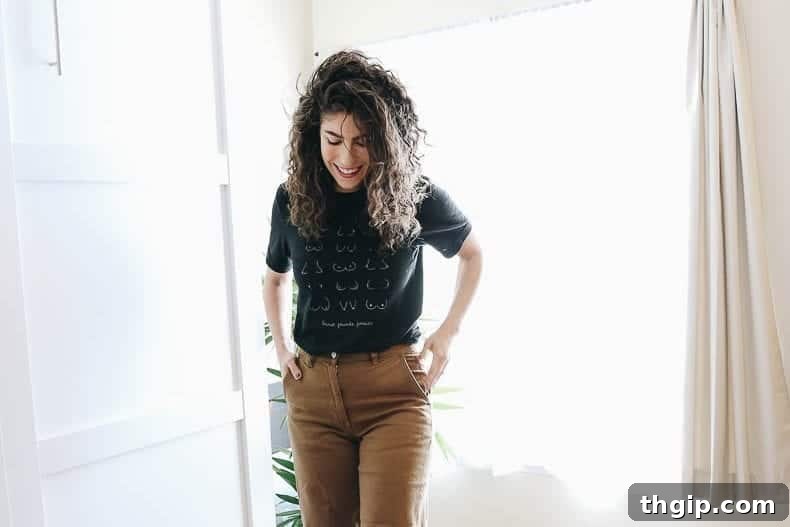
There are certain topics that demand a deeper dive, compelling us to confront long-held beliefs and emotional attachments. This particular narrative has lingered on my mental to-do list for months, perhaps because it necessitates a raw exploration of feelings—a practice we all understand the importance of, yet often postpone.
My journey into self-acceptance, particularly concerning my natural hair, has been profoundly illuminated by the principles encountered during my yoga teacher training. We’ve extensively discussed the Yamas and Niyamas, the foundational ethical code of the yogic lifestyle. Among these, the Yama known as “Aparigraha,” or non-coveting, stands out as a guiding light. I interpret Aparigraha not just as the act of not grasping or hoarding physical possessions, but more significantly, as the practice of releasing anything—tangible or intangible—that no longer serves your highest good. In a literal sense, this might mean regularly decluttering your home. But from an emotional and spiritual perspective, it’s about letting go of old ideas, limiting beliefs, or fabricated narratives we tell ourselves that lack truth or obstruct our greater purpose.
This Yama resonated with me with an almost startling clarity, as for the past several months, I have been actively dismantling a deeply ingrained narrative I’ve clung to for years: the belief that I am inherently “more beautiful” with straight hair.
Until quite recently, the notion of openly sharing such a personal vulnerability on the internet would have struck me as absurd. While I’ve always been candid about my struggles with various insecurities (many of which are documented here), I genuinely believed my curly hair wasn’t one of them. Looking back, my actions painted a very different picture. This insecurity was so deeply woven into the fabric of my self-perception that I simply stopped noticing it. It had become an unconscious default: beautiful equated to straight hair, while curly hair was lazily dismissed as unattractive or unkempt.
Articulating this belief now elicits a strong sense of discomfort, a cringe, because I recognize its profound falsehood. Yet, for so long, I remained oblivious to this toxic thought pattern, allowing it to dictate my self-image and daily routines.
The Unveiling: A Moment of Truth
The turning point arrived a few months ago during a self-love exercise. I was prompted to journal on a question designed to unearth deep-seated feelings: “What do you hate about yourself?” It’s a confronting inquiry, to be sure. My initial thoughts drifted to minor quirks, like my occasional obsessive thinking or my quick temper when hunger strikes. It wasn’t that I denied my imperfections; rather, I thought I had reached a place of embracing them as integral to my identity. But as pen met paper, an unexpected torrent of words—and subsequently, tears—began to pour out, revealing a truth I had long suppressed.
For context, I had just stepped out of the shower, allowing my hair to air dry slightly before embarking on my weekly ritual: straightening it. This had become a steadfast habit: once a week, I would meticulously wash and straighten my hair using a blow dryer and a flat iron. You may judge, but over three years, I had successfully “trained” my hair to maintain its straightness for an entire week before requiring another wash due to oiliness. Despite dreading this arduous, time-consuming process, I had faithfully performed it for a decade.
Each visit to the hairdresser would inevitably bring comments about the lifeless, brittle state of my hair ends. I was genuinely perplexed, convinced that my once-a-week use of hot tools was minimal. Yet, the reality was starkly different: for years, I had been coercing my hair into an unnatural form, subjecting it to immense stress. In retrospect, my hair was simply exhausted, and no amount of trims or deep-conditioning masks could rectify the deeper issue. The true transformation needed to originate from a more fundamental, internal shift.
The Brewing Storm: Seeds of Change
The internal “curly hair storm” had been quietly brewing for several months leading up to that pivotal journaling breakthrough. I had cautiously reached out to friends with naturally curly hair, whose straightened locks always appeared silky and healthy, seeking their wisdom. Almost unanimously, they urged me to consider a Keratin treatment. This wasn’t a new suggestion; in truth, I had contemplated it for years, always wavering, always held back by something. Primarily, the concern that it would eliminate the rare option of wearing my hair curly, should the mood strike. But also, the unsettling thought of saturating my scalp with chemicals to achieve those coveted silky-straight strands. My apprehension wasn’t with Keratin itself, a protein naturally produced by our bodies, but rather with the formaldehyde (or methylene glycol in “formaldehyde-free” versions) often mixed into these treatments, not to mention the myriad of other undisclosed ingredients.
The idea of committing to these treatments every few months, without a clear understanding of their long-term health implications, profoundly unsettled me. Nevertheless, encouraged by my friends, I booked an appointment at what seemed like a reputable and safe salon. I cleared three hours from my schedule, armed myself with a book and magazines, and mentally prepared for the transformation. My plans, however, changed within minutes. The kind stylist gently informed me that my hair ends were so severely damaged from years of hot tools that the Keratin treatment would only exacerbate the problem, likely necessitating a significant cut. This prospect, naturally, was far from thrilling. She sent me home with a recommendation for a nourishing hair mask and advised a break from hot tools for the next couple of months.
I left the salon feeling profoundly disappointed. I had emotionally braced myself for this change, so desperate to escape the weekly ordeal of straightening my hair that I would have done almost anything. Yet, this unexpected turn of events ignited an even deeper internal storm, one that ultimately led to one of the most enlightening and thought-provoking experiences of my recent life.
The Commitment: A New Beginning
Fast forward a few months. I found myself sitting there, tears streaming onto my journal, my wet hair dripping onto my robe. I finally, unequivocally, confronted the reality that I had been harboring deeply negative thoughts about my own curly hair, and that this realization demanded a drastic, immediate change. Stepping out of our bedroom, I announced to C that I was done straightening my hair. I was taking an indefinite break from my hot tools. That pivotal moment was six months ago, marking the true commencement of my journey.
The past six months have unfolded as an immersive journey of self-love and profound compassion. It has required me to fundamentally rewrite my personal definition of beauty and to delve deep into my past to understand when and how I veered so far off track in appreciating my natural self.
Truthfully, I can’t pinpoint the exact moment I learned to dislike my curls. I have faint, joyful memories of twirling them as a young child, delighting in their playful bounce. In elementary school, I would occasionally ask my mom to blow dry my hair straight, but it wasn’t a daily ritual. By high school, however, straightening my hair became a prerequisite for any dance or special occasion. Lacking the time to do it every day, my natural curly hair was relegated to casual days, while straight hair was reserved for moments when I felt the need to “impress.” By college, straightening was an almost daily affair, and when I met C in my early twenties, he literally had no idea I possessed curly hair because it was perpetually straight!
Even now, many people express surprise upon learning I have curly hair. My consistent straightening habits had completely obscured my natural ringlets, making it feel like I was carrying around a profound secret, one I desperately wanted to keep hidden.
Challenging Societal Norms and Media Influence
What I recognize now is the powerful, often insidious, influence of media and societal beauty standards on my self-perception, particularly regarding my hair. This realization strikingly parallels my past struggles with disordered eating. I once believed that being thin would make me more lovable, or more accurately, that once I achieved a certain weight, I could finally love myself. Eventually, I learned that true self-love has absolutely no correlation with the number on a scale or the size of my jeans. However, this hard-won wisdom hadn’t yet extended to my hair.
A crucial element missing from my life, and indeed from broader society, was hair diversity. I challenge you to observe the people you follow on social media or the characters you see on television: hair diversity is often conspicuously absent. Women are frequently pressured to display sleek, shiny hair, devoid of a single strand out of place. Frizz is deemed unacceptable, and embracing one’s natural texture is often lazily dismissed. Having straight hair is, in many ways, akin to being born with “thin-privilege”—it grants automatic societal acceptance without conscious effort. Anything that deviates from this narrow norm is often subtly or overtly deemed undesirable.
I realized that, unknowingly, I was not only influenced by this pervasive problem but also actively contributing to it by forcing my own hair into that restrictive box. While I am certainly not alone in perpetuating this issue, it is now my fervent desire that my actions never inadvertently influence another generation of girls to feel anything less than whole-heartedly beautiful in their natural state.
Aparigraha, Self-Love, and the Power of Acceptance
My journey with curly hair has been an extraordinary teacher, revealing that self-love is a vast tapestry encompassing every aspect of our being: our bodies, our values, our spiritual beliefs, our sexuality, and yes, even our hair. We sometimes spend so much time rehearsing the same self-deprecating stories that we become oblivious to the fact that we are actively reinforcing self-hatred. This experience has deepened my understanding of Aparigraha, prompting me to reflect on how much of my life I spent coveting and idealizing a specific hair type, while simultaneously rejecting and neglecting my own inherent beauty.
The irony is profound: as soon as I consciously decided to embrace my curls, many of my underlying fears—fears of not being beautiful, not being lovable, not being respected—began to dissipate almost miraculously. Initially, it required a degree of “faking it till you make it.” On an everyday basis, I felt increasingly comfortable with my curls, but it took significantly more courage to display them proudly at “big events.” And I won’t deny, I deeply internalized every compliment I received, as I hadn’t yet reached a place of full self-acceptance. But slowly, steadily, I have built a robust foundation of confidence.
It has now been six months since I last touched a hot tool, and I genuinely feel beautiful wearing my curls with pride and confidence. An unexpected joy has been the embrace of a vibrant curly girl community, one I never knew existed. The sheer number of women who have reached out to express gratitude for challenging societal pressures, and the deeply personal messages I received when I announced I was writing this post, have made this entire journey infinitely rewarding.
I’ve also learned the art of styling my curly hair, which, I’ll admit, isn’t always the easiest. Yet, I feel significantly less resistance to this process than I ever did with straightening. Experimenting with new products and techniques has actually become an enjoyable, creative outlet! Does this mean I will never straighten my hair again? My answer remains: never say never. I probably will occasionally, because variety can also be fun. But the most crucial lesson I’ve learned is this: I am no less beautiful when my hair is curly than when it is straight. In fact, I now wholeheartedly believe that curly hair possesses its own unique and undeniable beauty.
This profound journey has cemented a vital truth: self-acceptance must precede self-love. It is the indispensable bedrock upon which true self-love can blossom.
Your Emotional Junk Drawer: A Call to Introspection
We all harbor those hidden demons, tucked away in our emotional junk drawers. I understand that having curly hair is certainly not the most severe of these challenges, but it’s crucial to acknowledge that everyone possesses their own unique set of insecurities. Likewise, we all possess the innate capacity to confront and work through these insecurities, and in doing so, we often discover that the very things that once made us question our self-worth are precisely what make us beautifully and uniquely ourselves.
It’s remarkable how quickly my curly hair has woven itself into the rich tapestry of my personal identity. Embracing it not only makes me feel distinct but also empowers me to use my voice to celebrate difference—a sentiment I might have scoffed at just a year ago.
My request to you, dear reader, is this: courageously dig through your own emotional junk drawer. Bring to the surface those unconscious stories you’ve been telling yourself. Perhaps you dislike your ears, or your voice, or perhaps you hold a deep conviction that dogs are infinitely wiser than humans (if so… please reach out! I’m entirely with you on that one). Whatever your particular insecurity or unique belief, know that simply because something is different does not inherently make it bad, ugly, or foolish. It makes you, YOU—in all your magnificent individuality.
As the incomparable Oscar Wilde so eloquently put it, “Be Yourself. Everyone else is already taken.” There is profound liberation and power in that simple truth.
* * * * *
Curious to learn how I style my curly hair? Check out my latest video where I show you how to get curly hair!